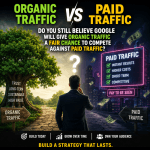
 Do you still believe Google will give organic traffic a fair chance, because for years, website owners and marketers have been told that content is king. Publish helpful articles, optimize them for search engines, earn backlinks, and Google will reward your efforts with free organic traffic.
But in today’s digital landscape, many marketers are asking a difficult question:
Does Google still give organic traffic a fair chance, or has paid advertising become the fastest—and sometimes only—way to get noticed?
The answer isn’t as simple as many people think.
The Growing Dominance of Paid Traffic
Search for almost any commercial keyword today and you’ll notice something immediately.
The top of Google’s search results is often filled with:
- Sponsored Ads
- Shopping Ads
- Local Business Listings
- AI-generated summaries
- Featured snippets
- Videos
- “People Also Ask” sections
Only after scrolling do you begin seeing traditional organic listings.
This has led many marketers to believe that organic SEO is becoming less valuable every year.
From a business perspective, it can certainly feel that way.
If your carefully written article appears halfway down the page while four paid advertisements occupy the top positions, it’s easy to conclude that paying Google is the only realistic option.
Why Many Marketers Are Choosing Paid Advertising
There are good reasons why businesses continue investing heavily in paid traffic.
Immediate Results
Unlike SEO, which may take months before rankings improve, paid advertising can begin generating visitors almost immediately.
Launch a campaign today.
Receive clicks today.
Generate leads today.
For businesses needing fast sales, this is extremely attractive.
Predictable Scaling
Paid traffic is easier to scale.
If one campaign performs well, increasing the advertising budget often increases website traffic.
Organic SEO doesn’t work that way.
Ranking improvements depend on hundreds of factors beyond your direct control.
Better Keyword Control
With paid campaigns you choose exactly which keywords trigger your advertisements.
Organic SEO is less predictable.
Google decides which search queries your content deserves to rank for.
Does That Mean Organic SEO Is Dead?
Absolutely not.
Organic traffic still delivers enormous value.
The difference is that earning it has become much more competitive.
Google wants to provide users with the best possible answers.
That means thin content, keyword stuffing, and AI-generated articles with little originality are struggling more than ever.
High-quality content still ranks.
But the bar has been raised considerably.
Why Google Isn’t Trying to Kill Organic Search
Many people assume Google simply wants everyone to pay for advertising.
While advertising generates significant revenue, Google also depends on users trusting its search results.
If every search produced only advertisements, people would quickly begin looking elsewhere.
Google succeeds because users believe they’ll find useful answers—not just sponsored offers.
Organic search remains essential to maintaining that trust.
The Real Challenge Facing Small Website Owners
The biggest obstacle isn’t necessarily Google’s preference for paid ads.
It’s competition.
Every niche now contains:
- Large authority websites
- Experienced SEO teams
- AI-assisted content production
- Thousands of competing blog posts
Publishing one article no longer guarantees visibility.
SEO has become a long-term investment rather than a quick strategy.
The Rise of AI Search
Artificial intelligence has changed search dramatically.
Google’s AI-generated summaries often answer questions directly within the search results.
Users sometimes receive enough information without ever clicking through to a website.
This affects both organic traffic and paid advertising strategies.
Businesses now need content that offers deeper insights, unique experiences, practical examples, and expert opinions that AI summaries cannot fully replace.
Should You Give Up on Organic Traffic?
No.
Instead, adjust your expectations.
Organic traffic should be viewed as building a long-term digital asset.
Every helpful article adds another opportunity for potential customers to discover your business.
Unlike paid traffic, organic content can continue attracting visitors months or even years after publication.
Paid ads stop generating traffic the moment you stop paying.
Organic content keeps working.
The Smartest Marketing Strategy
Successful marketers increasingly combine both approaches.
They use:
- Paid traffic for immediate visibility
- Organic SEO for long-term growth
- Email marketing to build an audience they own
- Social media to expand their reach
- Content marketing to establish authority
Diversification reduces dependence on any single traffic source.
Own Your Audience
One lesson many marketers have learned is this:
Never rely entirely on Google.
Search engine algorithms change.
Advertising costs increase.
Social media platforms evolve.
The safest long-term strategy is building an email list and a loyal audience that you can reach directly.
When visitors subscribe to your newsletter, you no longer depend entirely on search rankings or advertising budgets.
Final Thoughts
So, does Google still give organic traffic a fair chance to compete against paid traffic?
Yes, but not in the same way it once did.
Organic SEO is no longer the easy path to free traffic that it appeared to be a decade ago. Competition is fierce, search results are more crowded, and AI has changed how users interact with search engines.
However, organic traffic remains one of the most valuable long-term assets a business can build.
Paid traffic buys attention.
Organic traffic earns trust.
The businesses that thrive over the next decade won’t rely on just one source of visitors. They’ll invest in quality content, use paid advertising strategically, build email lists, and create a marketing ecosystem that continues working regardless of how Google’s algorithms evolve.
The question isn’t whether Google still give organic traffic a fair chance.
The better question is:
Are you building a business that can succeed even when Google changes the rules?